Platform Comparison · Operator Edition
Shopify vs WooCommerce: The Store Operator’s Comparison
For people who run stores, not platform philosophers: the fee arithmetic with verified rates, the app-stack economics, spike behavior, and the migration seam both directions cross. (Choosing a platform from scratch? Start with WordPress vs Shopify.) Updated August 2026.
The short version
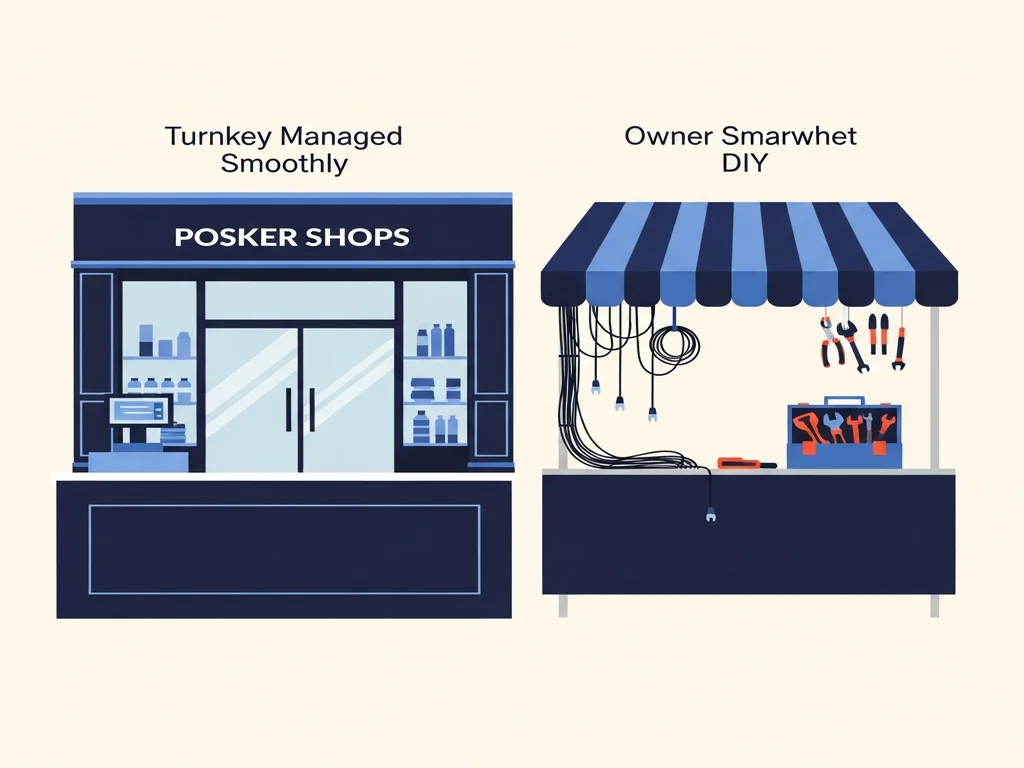
One question sorts operators faster than any table: when something breaks at 2am on launch night, whose problem do you want it to be? Shopify sells you that answer for a percentage of every sale. WooCommerce pays you that percentage back for owning the answer yourself.
Shopify is the operator’s call if…
- Nobody on the team should ever touch infrastructure
- Spikes, compliance, and uptime must be someone else’s job
- Multi-channel/POS are product features you’ll actually use
- Predictable fees beat variable ops costs for you
WooCommerce is the operator’s call if…
- Fee arithmetic at your volume favors zero platform take
- Checkout or business logic needs full ownership
- Content marketing is a primary growth engine
- Technical capacity exists — in-house or on retainer
At a glance: ten operator dimensions
| Dimension | Shopify | WooCommerce | Edge |
|---|---|---|---|
| Fee mechanics on every sale | 2.9%→2.5% + 30¢ via Shopify Payments by plan; +2%→0.6% surcharge if you bring another gateway. | Zero platform fee — only your processor’s rate (Stripe’s published standard: 2.9% + 30¢). | WooCommerce |
| Fixed monthly base | $39 / $105 / $399 verified (Aug 2026) — predictable, forever. | Hosting sized for commerce + extension renewals — variable, controllable. | Depends |
| Operations & PCI | The platform’s job: uptime, patching, compliance scope handled. | Your job, on a WordPress stack whose 2025 ecosystem logged 11,334 vulnerabilities (91% plugins). | Shopify |
| Spike resilience | Launches and holiday floods are invisible to you. | Your hosting architecture is the ceiling — test it before Black Friday does. | Shopify |
| Checkout control | Branding-level on standard plans; full Checkout Extensibility is Plus-gated (per Shopify docs). | Total: any field, rule, flow, or integration — it’s your code. | WooCommerce |
| App/extension economics | Rich app store; recurring per-app subscriptions accumulate on the invoice. | Extensions skew one-time/annual; total stack cost usually lands lower at equal features. | WooCommerce |
| Content & SEO machinery | Serviceable blog; content ops second-class. | WordPress underneath: the strongest content platform in mainstream use. | WooCommerce |
| Performance (field data) | 78% of desktop origins passed CWV (Nov 2025). | Rides WordPress’s 50% baseline — closable with serious hosting, not default. | Shopify |
| Data & ownership | Your data by policy, exportable; the store lives on their platform. | Structurally yours: database, customers, everything, portable. | WooCommerce |
| Multi-channel & POS | First-party product features: Markets, POS, channels. | Assembled via extensions; workable, not native. | Shopify |
Tally: Shopify 4 · WooCommerce 5 · Depends 1. Scale context: WooCommerce runs 48.4% of sites with known ecommerce tech (W3Techs, WooCommerce usage survey, surveyed 3 August 2026); Shopify dominates the professionally-operated tier.
The arithmetic, with verified inputs
Every number here traces to a live source. Shopify's published pricing (retrieved August 2026): plans at $39 / $105 / $399 monthly; Shopify Payments online card rates 2.9% / 2.7% / 2.5% + 30¢ by tier; bring-your-own-gateway surcharge 2% / 1% / 0.6%. WooCommerce takes nothing; processors charge their published rates (Stripe's published pricing: 2.9% + 30¢ standard) and your real costs are hosting, extensions, and labor.
What the arithmetic teaches at typical volumes: the platform-fee spread is smaller than the rhetoric — at Basic tier with Shopify Payments, Shopify’s take above raw processing is essentially the $39 base; the surcharge only bites if you bring your own gateway. The spread that actually decides is operational: WooCommerce’s “savings” fund your hosting, updates, and incident response (Patchstack, State of WordPress Security 2026 quantifies the stakes: 11,334 ecosystem vulnerabilities in 2025, 91% plugin-layer), while Shopify’s fees fund invisibility — 78% CWV field baseline (WebVitals.tools platform benchmarks (CrUX + HTTP Archive)), handled spikes, handled compliance. High-volume stores with engineering teams flip the math; the checkout wall (Shopify Help Center, checkout customization documentation: full extensibility is Plus-gated) flips it for anyone with exotic flows.
Shopify vs WooCommerce: FAQ
Operator questions, answered with verified inputs.
Where we stand
Webvello does WordPress/WooCommerce work and Shopify storefront work — both sides of this page are services we sell, which is why the arithmetic uses verified public rates instead of our opinion.
Keep going
The pillar guide: Choosing a Website Platform in 2026All the comparisons, one decision framework, full evidence appendix.WordPress vs Shopify
The platform-chooser edition of this matchup.
Read the guideShopify vs Custom Website
When the store outgrows every platform’s rails.
Read the guideShopify Development
Storefront engineering on the rails, done deliberately.
ExploreEcommerce Design
Conversion-focused store design on either stack.
Explore